

Life at Coler: Nora Kay’s Journey Through Family, Land, and Legacy
A Place Full of Memories
When Nora Kay and Johnny got married in 1979, they made their home at Coler. For 20 years, they raised their family here, surrounded by open fields, deer and turkeys, and the soft glow of lightning bugs along the dirt road that led them home.
“When the lightning bugs were really out, you could almost turn your lights off on your vehicle and see to go down the lane. It was very pretty.”
That dirt lane wasn’t paved back then. In summer, it was peaceful and alive with nature. In winter, it could turn into a challenge.
“During one bad snowstorm, trees were just down all down through the lane and it took us two or three hours to get home after work, cutting our way through there.”
The creek running through Coler has changed over the years.
“There was a lake at the other end with a dam, and they took the dam out so that allows more water to come down through here. We had quite a bit of water, but nothing like what we have today.”
Her children, Stevie and Mandy, grew up exploring and playing in the creek, much like children visting Coler still do!
“My son Stevie and Mandy, my daughter, would get out here and go down the creek in their floaties.”
Coler wasn’t just where they lived. It was where generations of Johnny’s family worked the land, planted gardens, and built traditions that still linger in every corner of the homestead.
The Heart of the Homestead: Oscar and Esther’s Legacy
Johnny’s grandparents, Oscar and Esther (known as Papaw and Mamaw), lived just beyond the barn. Their house was simple at first, just a kitchen, living room, and bedroom. Oscar later added on to the living room, carefully doing the stonework himself.
“They didn’t have running water or a bathroom. The outhouse was a good walk from the house, and in the winter that made for some chilly visits.”
One of Oscar’s greatest accomplishments was the well.
“The well that’s here, Oscar dug that. It’s 25 feet deep, and he hand-dug the whole thing.”
The Barns That Still Stand
Oscar’s skill and determination showed in more than just the house. He also built the barns that still stand at Coler today. He cut the trees, hewed the boards, and constructed the buildings piece by piece. Those barns sheltered animals, stored feed, and became the center of daily farm life.
Farming, Cows, and Mules
Oscar always kept a dairy herd that supplied the family with milk. He also planted large gardens—one near the house for vegetables and another near the barn for potatoes. After harvest, potatoes and canned vegetables were stored in the root cellar.
“It was always cool in the summer and never as cold as the outside during the winter.”
He relied on his well-trained mules to plow the gardens. They were so gentle that the grandchildren could ride them or be pulled in a sled through the fields.
Oscar’s Studebaker truck was a familiar sight on the property too. He used it to harvest corn, hauling some to the Co-op in Bentonville to be ground into feed for the cows and storing the rest in the barn.
Life on the farm followed the steady rhythm of planting, tending, harvesting, and storing. With mules in the fields, cows in the barn, food in the root cellar, and flowers on the table, the Coler homestead was alive with both work and beauty.
Life Inside the Home
The house was heated with wood stoves—one in the kitchen and another in the living room. For many years, meals were cooked on a wood stove as well. It was a home built on hard work, resourcefulness, and a love for family.
Mamaw’s Flowers and Curiosity
Esther loved beauty and filled the homestead with it. Daffodils covered the creek banks and stretched back toward Airship, lighting up the land each spring. She also created a rock garden made up of stones collected from all over—some with fossils, others with unusual shapes, many given to her by family and friends from their travels.
“We had flowers everywhere. Daffodils would just cover by the creek and all the way back towards Airship.”
She also had a curious mind and a teacher’s heart. Esther carefully taped leaves from every tree she could find on the property onto sheets of paper, writing out the name of each tree in her own hand. Alongside the leaves, she also archived small branches of wood from different trees, labeling each one as part of her system.
“Like Mamaw, that’s her own writing—the different leaves and what they were.”
These pages and wood samples are still preserved today, offering a glimpse of her knowledge and her love of the land.
Every Sunday she would cut fresh bouquets and take them to New Home Church. It was her way of bringing the beauty of the land inside to share with her neighbors and community.
She loved animals, especially dogs, and there was always one on the farm. But she had no tolerance for snakes. Family remembers her chasing them off with whatever she could grab, determined to keep them away from the house and gardens.
Faith, Family, and Community
Oscar and Esther were devoted members of New Home Methodist Church, which still stands today. Oscar taught the adult Sunday School class and served as superintendent, while Esther taught the younger class. At Christmas, Oscar read the Nativity story aloud, a family tradition everyone looked forward to.
Esther’s contributions went beyond the church doors. She was active in the New Home Demonstration Club, where she shared her skills with other women in the community. She also used the loom stored in the old schoolhouse to weave rugs, turning scraps into something both useful and beautiful. On top of that, she served as a community correspondent for the Benton County Democrat for more than 40 years, keeping neighbors connected through her writing.
Both Oscar and Esther are buried at New Home Cemetery, right beside the church where they spent so much of their lives in service and fellowship.
Oscar’s Life Before the Farm
Oscar Melvin Torell was born in Nebraska on April 2, 1893. He graduated from Luther College in Wahoo, Nebraska, and began his career as a teacher. He taught in Nebraska before moving to Arkansas in 1930, where he continued teaching in Cave Springs, Vaughn, and Miller. He retired from teaching in 1947 to farm full-time.
Esther Victoria Brodahl was born on December 7, 1895. Together, she and Oscar raised their family, built their home, and poured their lives into the Coler land until Oscar’s death in 1974 and Esther’s in 1994.
Preserving the Land, Preserving the Story
As time passed, Nora and Johnny wondered what would become of the land.
“We kind of thought they would put in a bunch of houses all over the hillside like they’ve done everywhere else here.”
Instead, the property was preserved.
“To find that they did this—it just made us so happy. My husband was still alive then. We were very pleased. I am just totally honored that y’all made us part of this, because you didn’t have to. It could have been about something else. But to know that they’re preserving all of this is wonderful.”
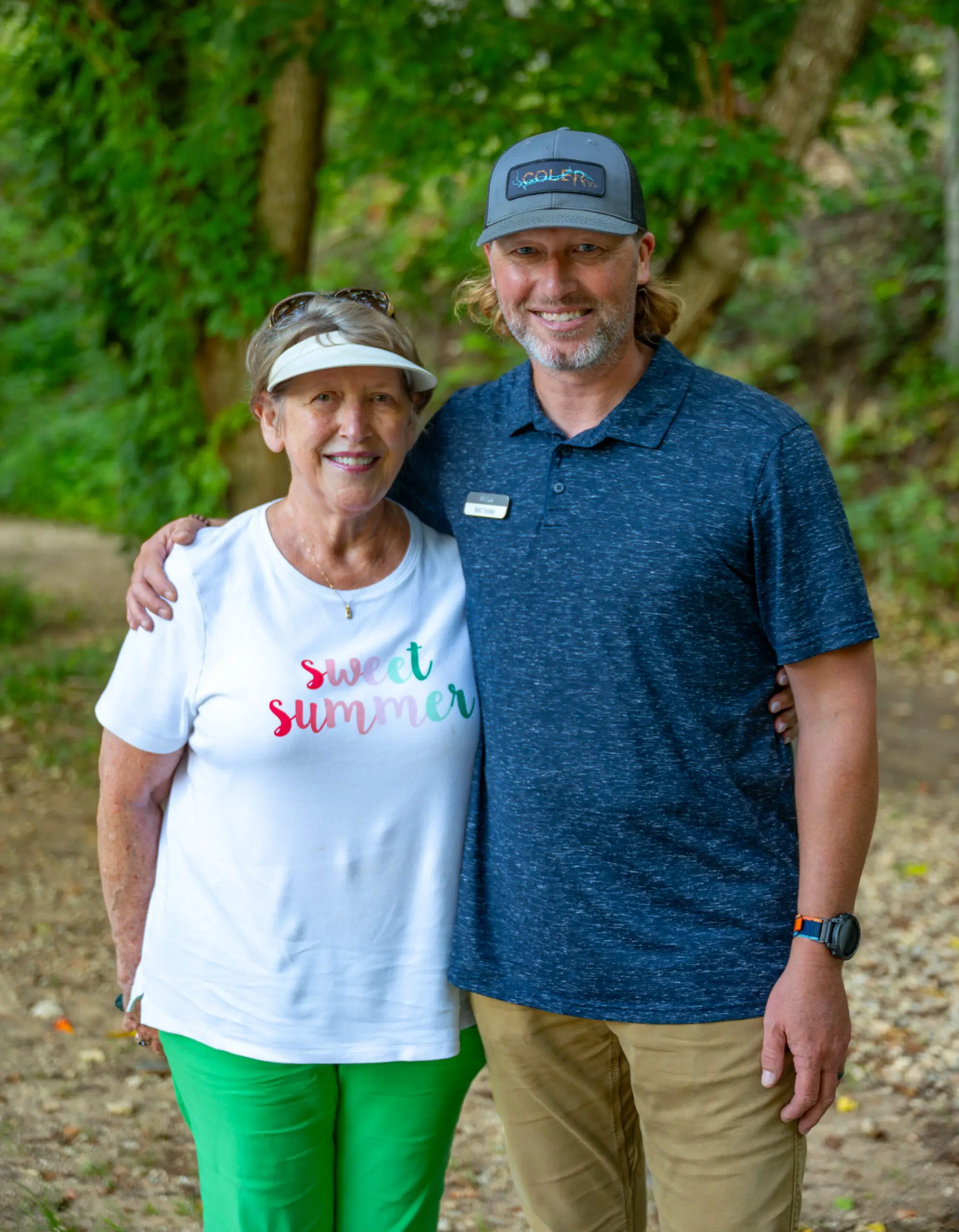
Nora Kay Coler with Coler Mountain Bike Preserve Site Manager, Matt Timboe.