
Parlor
Self-Guided House Tour
English
Audio Script
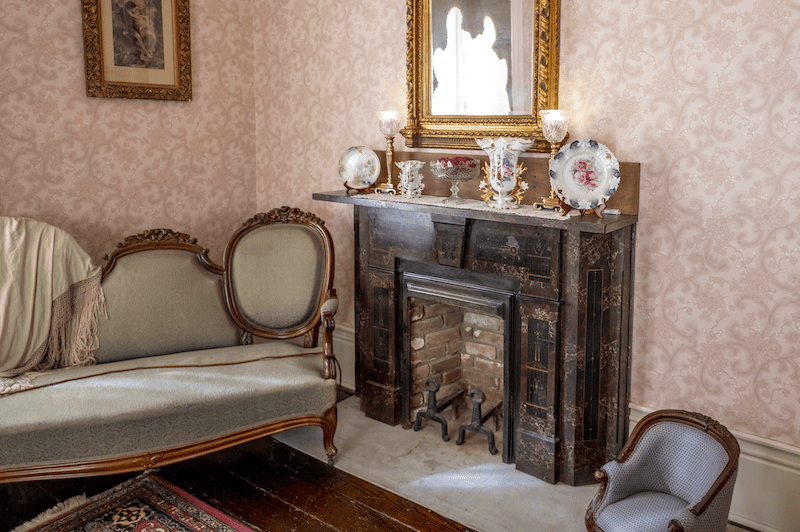
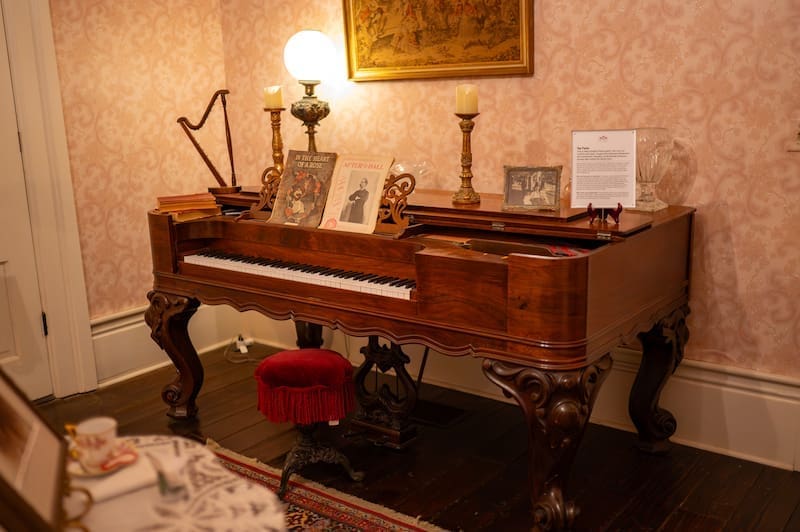
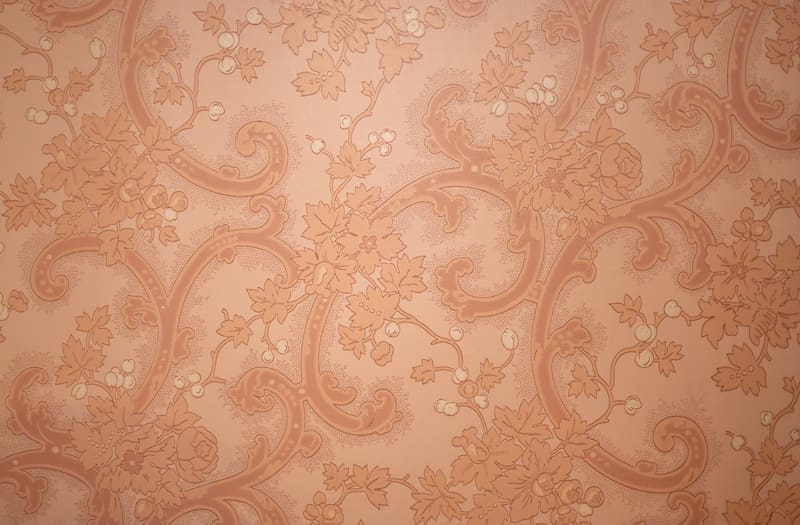
As you look around the room, notice how it’s decorated and what colors are used. Mary Emaline decorated this space to reflect the prosperity of her family and to impress the important guests they entertained. As you can see by the wall color in this room and others, Mary Emaline adored the color pink. Pink wasn’t commonly used in such a bold way during this period, but it’s clear Mary Emaline liked to push the boundaries in terms of interior design.
Look up at the ceiling and observe the chandelier medallion. This architectural piece is original to the home, which is significant because it reminds us that Mary Emaline selected this particular design to include in her treasured parlor.
Direct your attention to the window treatments. Our restoration team selected this design from a book called The American Woman’s Home, which was co-authored by Harriet Beecher Stowe and her sister Catherine Beecher. The book itself is displayed in front of the window, as well as the page depicting the window treatments that inspired our design.
Mary Emaline and Samuel had nine children, and of those nine children, six were girls. One of the highest priorities of a Victorian parent was to make sure your daughters were married to upstanding gentlemen in society. Dating in the Victorian era was referred to as courting, and this room is where the courting rituals took place.
A courting couple could not be left alone. They were to be monitored by a chaperone at all times. Notice the two sofas sitting at the far end of the room. These are called “courting sofas” and they are made to seat a courting couple who would be separated by a chaperone sitting between them. Notice how the middle headrest on these couches is lower than the outer headrests. This was designed to make sure the chaperone didn’t get too comfortable. They didn’t want her to lean her head back and fall asleep, leaving the couple unattended.
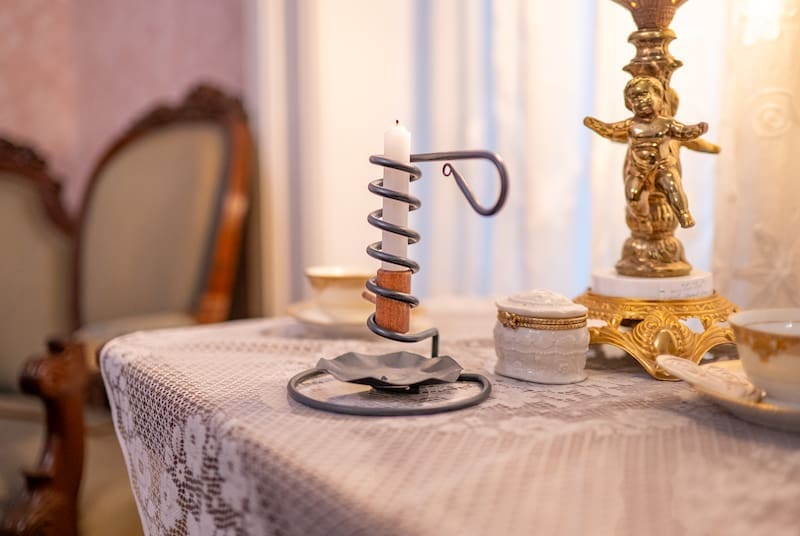
On the table between the “courting sofas” is a candle inside of a spiral candle holder. Feel free to pick it up and see how it works. This is called a “courting candle” and it was used as a timer for the courting couple. Mr. And Mrs. Peel could determine how much time a gentleman could spend with their daughter by moving the candle up or down by rotating the wooden slide. The gentleman had until the candle burned down from the top of the candle to the top of the spiral to impress the Peel girl and her family. If they liked him, they could move the candle up giving them a longer date. If they didn’t like him, they could lower the candle to cut the date short.
You can now make your way to the dining room located through the door under the stairwell.
Español
Letra De Audio
Al mirar alrededor de la habitación, observe cómo está decorada y qué colores se usan. Mary Emaline decoró este espacio para reflejar la prosperidad de su familia e impresionar a los invitados importantes que entretuvieron. Como se puede ver por el color de la pared en esta habitación y otras, Mary Emaline adoraba el color rosa. El rosa no se usaba comúnmente de una manera tan audaz durante este período, pero está claro que a Mary Emaline le gustaba empujar los límites en términos de diseño de interiores.
Mire hacia el techo y observe el medallón de la araña. Esta pieza arquitectónica es original de la casa, lo cual es significativo porque nos recuerda que Mary Emaline seleccionó este diseño en particular para incluirlo en su preciado salón.
Dirija su atención a los tratamientos de ventanas. Nuestro equipo de restauración seleccionó este diseño de un libro llamado The American Woman’s Home, que fue co-escrito por Harriet Beecher Stowe y su hermana Catherine Beecher. El libro en sí se muestra frente a la ventana, así como la página que representa los tratamientos de las ventanas que inspiraron nuestro diseño.
Mary Emaline y Samuel tuvieron nueve hijos, y de esos nueve hijos, seis eran niñas. Una de las mayores prioridades de un padre victoriano era asegurarse de que sus hijas estuvieran casadas con caballeros honrados en la sociedad. Las citas en la época victoriana se conocían como cortejo, y esta habitación es donde tenían lugar los rituales de cortejo.
Una pareja de cortejo no podía quedarse sola. Debían ser monitoreados por un acompañante en todo momento. Observe los dos sofás sentados en el otro extremo de la habitación. Estos se llaman “sofás de cortejo” y están hechos para sentar a una pareja de cortejo que estaría separada por un chaperón sentado entre ellos. Observe cómo el reposacabezas central en estos sofás es más bajo que los reposacabezas exteriores. Esto fue diseñado para asegurarse de que el acompañante no se sintiera demasiado cómodo. No querían que ella inclinara la cabeza hacia atrás y se durmiera, dejando a la pareja desatendida.
En la mesa entre los “sofás de cortejo” hay una vela dentro de un candelabro en espiral. Siéntase libre de recogerlo y ver cómo funciona. Esto se llama una “vela de cortejo” y se usó como temporizador para la pareja de cortejo. Peel podía determinar cuánto tiempo podía pasar un caballero con su hija moviendo la vela hacia arriba o hacia abajo girando el tobogán de madera. El caballero tenía hasta que la vela se quemó desde la parte superior de la vela hasta la parte superior de la espiral para impresionar a la chica Peel y su familia. Si les gustaba, podían mover la vela hacia arriba dándoles una fecha más larga. Si no les gustaba, podían bajar la vela para acortar la fecha.
Ahora puede dirigirse al comedor ubicado a través de la puerta debajo del hueco de la escalera.