
Study
Self-Guided House Tour
English
Audio Script
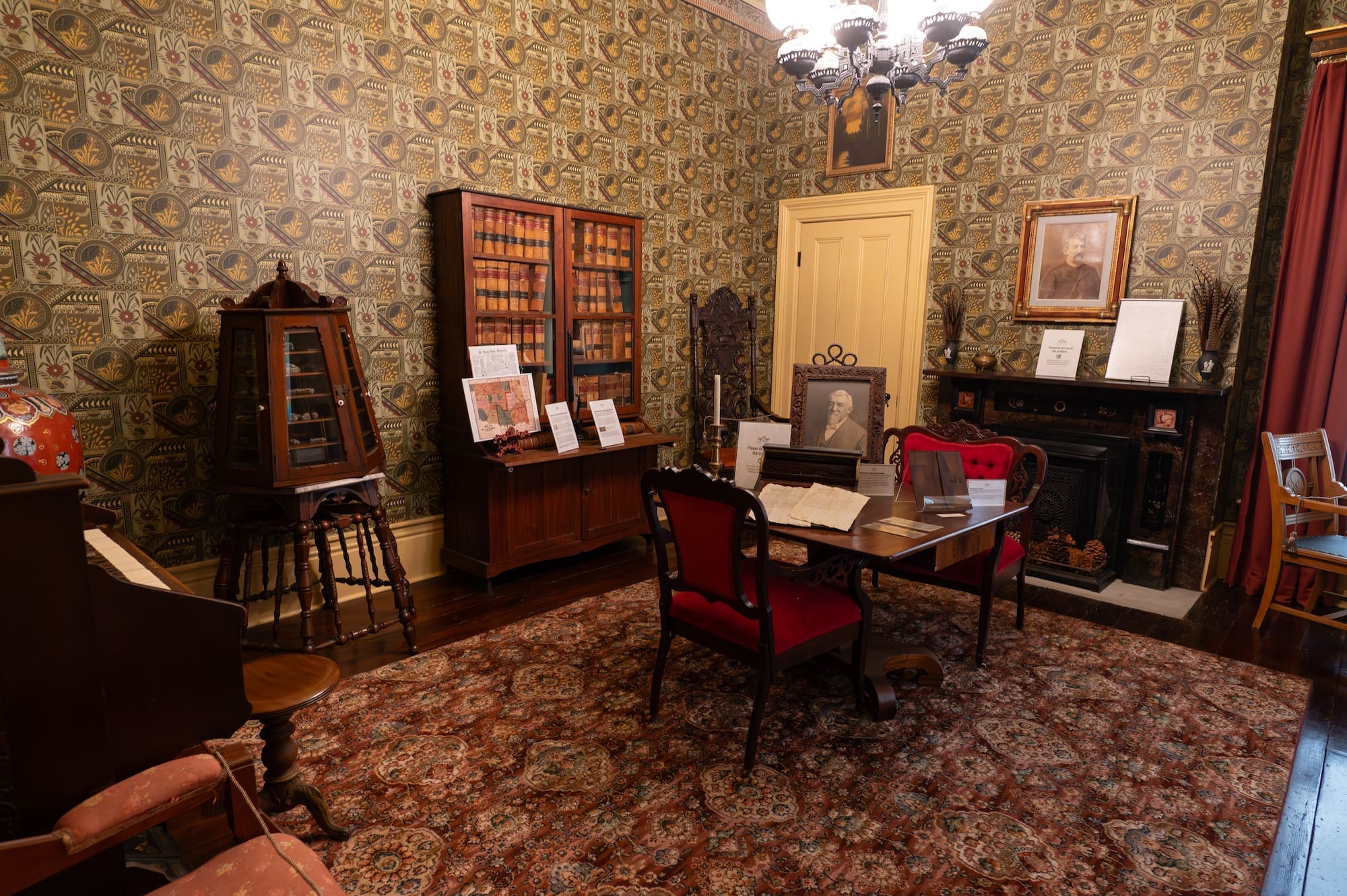
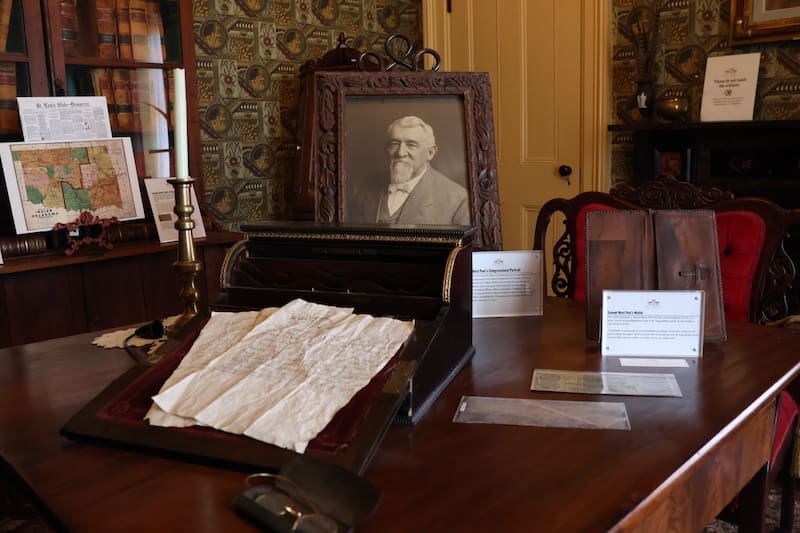
There are two portraits of him, one on the central table and one above the fireplace. Samuel West Peel was born in Independence County, Arkansas on September 13, 1831 to parents John and Elizabeth Peel.
After his mother died when Samuel was just four years old, the family moved to Carroll County, Arkansas where he spent the first part of his life. Samuel grew up working in his father’s retail store and also served as a legal clerk. On January 30, 1853 at the age of 21, Samuel finally married his long-time sweetheart Mary Emaline Berry and they quickly began growing their family.
The Civil War erupted in April 1861, and Arkansas seceded from the United States soon after. It was then that thirty-year-old Samuel Peel joined the Confederate Army, and during the course of the Civil War, he quickly rose from the rank of private to colonel. Samuel fought in many local battles, including the Battle of Prairie Grove and the Battle of Wilson’s Creek.
Take a look at the document sitting on the hutch next to the fireplace. This is a copy of Colonel Peel’s letter of amnesty, which he wrote on June 14, 1865, just nineteen days after the Confederacy lost the war. Confederate officers were required to write this letter in order to rejoin many parts of civil society. In it, Samuel Peel pledges to defend the constitution despite his role as a confederate officer. He petitions President Andrew Johnson to reinstate his citizenship, and is granted amnesty in 1866, which renewed his right to own property, own a business, and run for public office.
After the end of the devastating war, Samuel and Mary Emaline moved their family here to Bentonville to begin a fresh life in northwest Arkansas. While here, Samuel practiced law, opening a practice with his brother-in-law James Henderson Berry. Take a look at the wallet on the central table. This is actually Samuel Peel’s wallet, which was donated to the museum by the Peel family.
Samuel Peel is an historic figure in Arkansas, as he was the first native Arkansan to represent the state of Arkansas in Congress. He was elected to serve from 1883-1893 in the United States House of Representatives, also serving as the Chairmen for the House Committee on Indian Affairs. After a decade in Congress, Samuel returned to his law practice in Bentonville and was hired by Native American tribes, including the Chickasaw and Choctaw Nations, to represent their interests in court.
Samuel West Peel died on December 18, 1924 in Bentonville, Arkansas at the age of 93.
You can now make your way across the Foyer to the Parlor room where your visit will continue.
Español
Letra De Audio
La Guerra Civil estalló en abril de 1861, y Arkansas se separó de los Estados Unidos poco después. Fue entonces cuando Samuel Peel, de treinta años, se unió al Ejército Confederado, y durante el curso de la Guerra Civil, rápidamente ascendió del rango de soldado raso a coronel. Samuel luchó en muchas batallas locales, incluyendo la Batalla de Prairie Grove y la Batalla de Wilson’s Creek.
Eche un vistazo al documento sentado en la cabina junto a la chimenea. Esta es una copia de la carta de amnistía del coronel Peel, que escribió el 14 de junio de 1865, solo diecinueve días después de que la Confederación perdiera la guerra. Los oficiales confederados debían escribir esta carta para reincorporarse a muchas partes de la sociedad civil. En él, Samuel Peel se compromete a defender la constitución a pesar de su papel como oficial confederado. Le pide al presidente Andrew Johnson que restablezca su ciudadanía, y se le concede una amnistía en 1866, que renovó su derecho a poseer propiedades, poseer un negocio y postularse para un cargo público.
Después del final de la devastadora guerra, Samuel y Mary Emaline mudaron a su familia aquí a Bentonville para comenzar una nueva vida en el noroeste de Arkansas. Mientras estuvo aquí, Samuel ejerció la abogacía, abriendo una práctica con su cuñado James Henderson Berry. Echa un vistazo a la billetera en la mesa central. Esta es en realidad la billetera de Samuel Peel, que fue donada al museo por la familia Peel.
Samuel Peel es una figura histórica en Arkansas, ya que fue el primer nativo de Arkansan en representar al estado de Arkansas en el Congreso. Fue elegido para servir de 1883 a 1893 en la Cámara de Representantes de los Estados Unidos, y también se desempeñó como Presidente del Comité de Asuntos Indígenas de la Cámara. Después de una década en el Congreso, Samuel regresó a su práctica legal en Bentonville y fue contratado por tribus nativas americanas, incluidas las naciones Chickasaw y Choctaw, para representar sus intereses en los tribunales.
Samuel West Peel murió el 18 de diciembre de 1924 en Bentonville, Arkansas a la edad de 93 años.
Ahora puede cruzar el vestíbulo hasta la sala de estar, donde continuará su visita.